Technical
Two-and-a-half litres, force-fed.
A KKK-blown SOHC four — 247 hp, 350 Nm, 0.8 bar of boost — driving through a limited-slip transaxle, in the rarest and most desirable 944 of all.
M44.52·2479 cc·SOHC 8v·Bosch Motronic·KKK K26/8·G016R transaxle·LSD 40%·Koni adjustable·16-inch staggered·ASC soft top
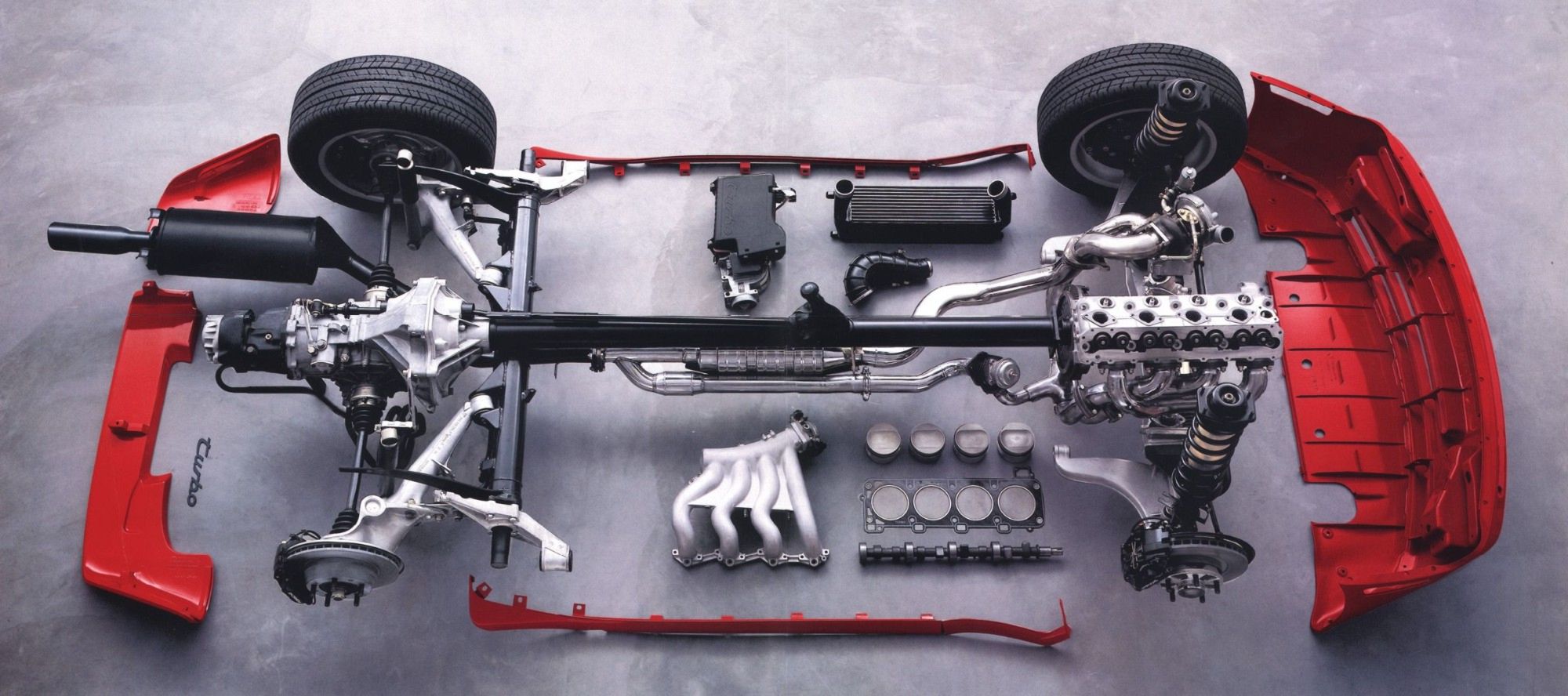
Bodywork
Front bumper
MaterialPolyurethane
FunctionCooling ducts, front lift
The 944 Turbo's front spoiler provides better air intake and aerodynamics.
Bodywork
Rear diffuser
MaterialPolyurethane
The rear diffuser, or valance, provides cleaner undercar airflow and reduces drag.
Chassis
Staggered 16-inch wheels
Front16×7.5 ET65 · 225/50 VR16
Rear16×9 ET60 · 245/45 VR16
Fitment5×130 · 71.6 mm bore
Wider at the back than the front — the staggered fitment that gives the Turbo its stance and its traction. Bolt pattern and centre bore are shared with the 911 of the period.
Bodywork
Sill covers
PositionBoth sides
FixingClipped to the shell
The rocker covers closing the gap between the front and rear aprons. On the Cabriolet they sit on a shell with substantial extra bracing beneath the floor, recovering the stiffness lost with the roof.
Exhaust
Exhaust system
LayoutSingle, full length
OutletSingle tailpipe
From the turbine outlet the exhaust runs the length of the car, under the torque tube, to the silencer at the tail. The turbocharger takes so much energy out of the gas flow that a 951 is markedly quieter than a naturally aspirated 944.
Drivetrain
G016R transaxle
Gearbox5-speed, rear-mounted
CodeAOR
Limited slip40% lockup
Final drive3.375:1
Transaxle gearbox is located at the back of the car — the layout that gives the 944 Turbo close to 50/50 weight distribution. The G016R (code AOR) carries a 40% limited-slip differential as standard, with reinforced inner plates and molybdenum-coated shafts. Gearbox also has an external oil cooler.
Drivetrain
Torque tube
FunctionEngine to transaxle
ShaftRigid, constantly turning
A rigid tube bolting the engine to the transaxle, with the drive shaft spinning inside it on its own bearings. The shaft turns at engine speed whenever the engine runs, clutch in or out — the clutch sits at the far end, on the gearbox.
Chassis
Front suspension
LayoutMacPherson strut
DampersKoni, height-adjustable
Struts with lower wishbones and an anti-roll bar.
Chassis
Rear suspension
LayoutSemi-trailing arms
DampersKoni, height-adjustable
Cast aluminium trailing arms carrying the rear hubs, with an anti-roll bar across the car ahead of them. The transaxle sits between them, which is why the back of a 944 Turbo is so much busier than the front.
Top end
M44.52 head, camshaft & manifold
ValvetrainSOHC, 8 valves
Displacement2479 cc
Output247 hp @ 6000 rpm
CamshaftSingle, belt-driven
Two valves per cylinder and a single overhead camshaft.
Bottom end
Pistons & head gasket
Pistons4 · oil-cooled crowns
Bore spacing122 mm
Bore size100 mm
Stroke78.9 mm
Displacement2479 cc
The turbo engine's own internals: lower-compression pistons with oil-sprayed crowns, a thicker head gasket to match, and the single camshaft working all eight valves.
Forced induction
KKK K26/8 turbocharger
ChargerK26/8
Max boost0.8 bar
Fuel systemBosch Motronic
KKK — originally Kühnle, Kopp & Kausch, now part of BorgWarner Turbo Systems. The manifold beneath the head feeds it; the downpipe above carries the gas away. The dashboard gauge reads absolute manifold pressure, peaking at 1.8 bar, while the turbo makes roughly 0.8 bar of gauge boost above atmospheric.
Charge cooling
Intercooler
TypeAir-to-air
FeedFront apron ducting
The intercooler sits between compressor and throttle to give that density back — and the cooler charge buys the detonation margin that lets the 944 Turbo run its boost on pump fuel.
Intake & Engine management
Airbox & Motronic
Engine managementBosch Motronic
MeteringAir-flow sensor
ControlIgnition + injection
Bosch Motronic runs ignition and injection from one control unit, reading engine speed, load and knock. The knock sensing is what makes the boost usable: timing is pulled the instant detonation is heard, rather than tuned defensively for the worst fuel the car might ever see.
Chassis
Brakes
CalipersBrembo 4-piston
Rotors, front304 mm × 28 mm ventilated
Rotors, rear299 mm × 24 mm ventilated
The front brakes were borrowed from the Porsche 928 S4, with larger Brembo 4-piston fixed calipers and 304 mm discs. Both front and rear discs are ventilated. ABS is a standard option.
944
Turbo Cabriolet
The boost hits first. The grin follows.
Three systems, one purpose.
01 — Forced induction
KKK K26/8 turbo
- Charger
- K26/8
- Max boost
- 0.8 bar
- Fuel system
- Bosch Motronic
KKK — originally Kühnle, Kopp & Kausch, now integrated into BorgWarner Turbo Systems.
The 944 Turbo's dashboard gauge displays absolute manifold pressure at 1.8 bar, whereas the turbocharger produces approximately 0.8 bar of gauge boost pressure above atmospheric.
02 — Drivetrain
G016R transaxle
- Gearbox
- 5-speed, rear
- Final drive
- 3.375:1
- Limited slip
- 40% lockup
G016R (code AOR) transaxle gearbox comes with 40% LSD as standard with reinforced inner plates and molybdenum coated differential shafts.
1st and 2nd gears on drive shaft are blasted for extra strength.
Final drive: 3.375
Gear ratios:
· 1st gear: 3.500
· 2nd gear: 2.059
· 3rd gear: 1.400
· 4th gear: 1.034
· 5th gear: 0.829
03 — Chassis
Koni suspension
- Dampers
- Height-adjustable
- Front
- 225/50 VR16
- Rear
- 245/45 VR16
Front Setup:
· Wheel size: 16" × 7.5
· Offset ET65
· Tire Size: 225/50 VR16
Rear Setup:
· Wheel Size: 16" × 9
· Offset: ET60
· Tire Size: 245/45 VR16
Bolt Pattern: 5 × 130 mm
Center Bore: 71.6 mm